
October 2026 Newsletter
octobre 28, 2026
CLEAR 2026 Annual Educational Conference
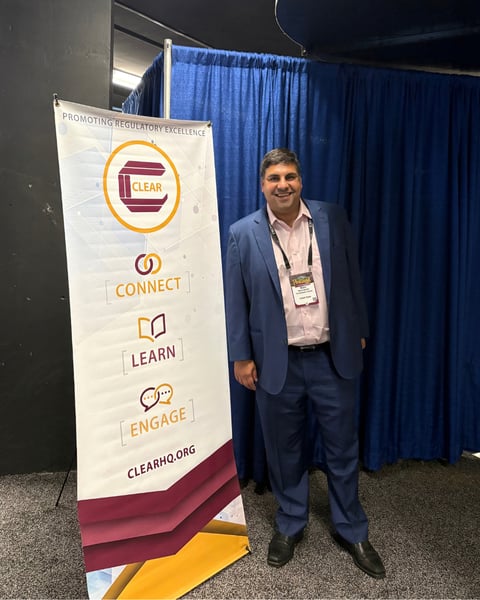
Mukul Bakhshi, our Chief Legal and Compliance Officer, and Talia Freelund, Senior Institutional Liaison, joined more than 500 regulators in Portland for CLEAR’s 46th Annual Educational Conference. Four days of sessions on entry to practice standards, testing, and regulatory governance, and a lot of good conversation in between.

American Academy of Nursing Health Policy Conference
Mukul Bakhshi will be there for this year’s theme, Digital Health: Promise, Responsibility.
Conference Details
TAICEP Annual Conference
Susan Whipple, Chris Fell, and Nevena Nikolic will be at the credential evaluation profession’s own gathering, at the Halifax Marriott Harbourfront.
Conference Details
SIENNA 2nd IEN Global Conference and Policy Congress
Internationally educated nurses, educators, and policymakers, on the theme Building Community. Empowering Nurses. Advancing Together.
Conference DetailsThe Duration of Status rule is on hold
On September 14, one day before it was scheduled to take effect, a federal court in Massachusetts blocked the DHS rule that would have ended duration of status for F, J, and I visa holders. The rule was published July 17 with a September 15 effective date. A coalition led by the Presidents’ Alliance on Higher Education and Immigration and NAFSA: Association of International Educators sued on August 18 and asked the court to pause it. The court agreed.
- What the court did. Judge F. Dennis Saylor IV issued a nationwide preliminary injunction, finding the government’s justifications for the rule arbitrary and capricious and the harm from letting it take effect immediate. DHS cannot implement or enforce the rule while the injunction stands.
- What stays in place. The existing framework. Eligible F and J students and scholars may remain in the United States for the length of their program, research, or practical training, as long as they continue to maintain status. Nothing about how you advise a current student changes today.
- This is not the end of it. A preliminary injunction is a temporary measure, not a final ruling. The case is still moving forward, and the rule could take effect later if the injunction is lifted or overturned on appeal.
- What would change if it does. Fixed admission periods based on program length and capped at four years, extension of stay applications filed with USCIS, new restrictions on changing majors or education levels, and a shorter F-1 post-program grace period of 30 days instead of 60 for new admissions. F-2 and J-2 dependents would face the same fixed admission and extension requirements.
- The travel wrinkle to remember. Students and scholars already in the country when the rule takes effect would be phased in gradually, but anyone who leaves and reenters afterward would be admitted under the new fixed period. Worth flagging early for anyone planning to travel.

Nevena Nikolic
Nevena holds a bachelor’s degree in Chinese Language and Literature from the University of Belgrade and a master’s in East Asian Studies from the University of Toronto. Through the Canada-China Scholars’ Exchange Program and the Youth International Internship Program, she studied and worked in Beijing and Xiamen. She came back and started what became a 23-year career at World Education Services, with contract work for ACEI and FIS along the way, before joining TEC.
“I find each education system interesting in different ways. I enjoy observing how systems evolve over time, how institutions change, how new programs emerge, and how educational pathways adapt to meet the needs of students and society.”
That long view is the part worth borrowing. An institution that looked one way a decade ago may not look that way on the transcript in front of you now, and knowing which changes matter is most of the job. Outside of TEC, Nevena is usually outdoors with her family and her dogs, gardening, hiking, kayaking, or skating on Nova Scotia’s lakes in winter.
- Favorite place traveled
- Tunisie
- Cuisine
- Vegan japchae
- Teammates would say
- Reliable
- Alternate career
- Wildlife rehabilitation
- Book
- La Montagne Magique
- Film
- Les ailes du désir
Have a credential question your team keeps arguing about? Send it over, and we’ll answer one in every issue.
Send your question